storage
Under-Bed Storage That Actually Works in a Small Apartment
The floor beneath your bed is some of the most underused real estate in a small apartment. These storage solutions make it earn its keep without requiring a single wall anchor or landlord approval.
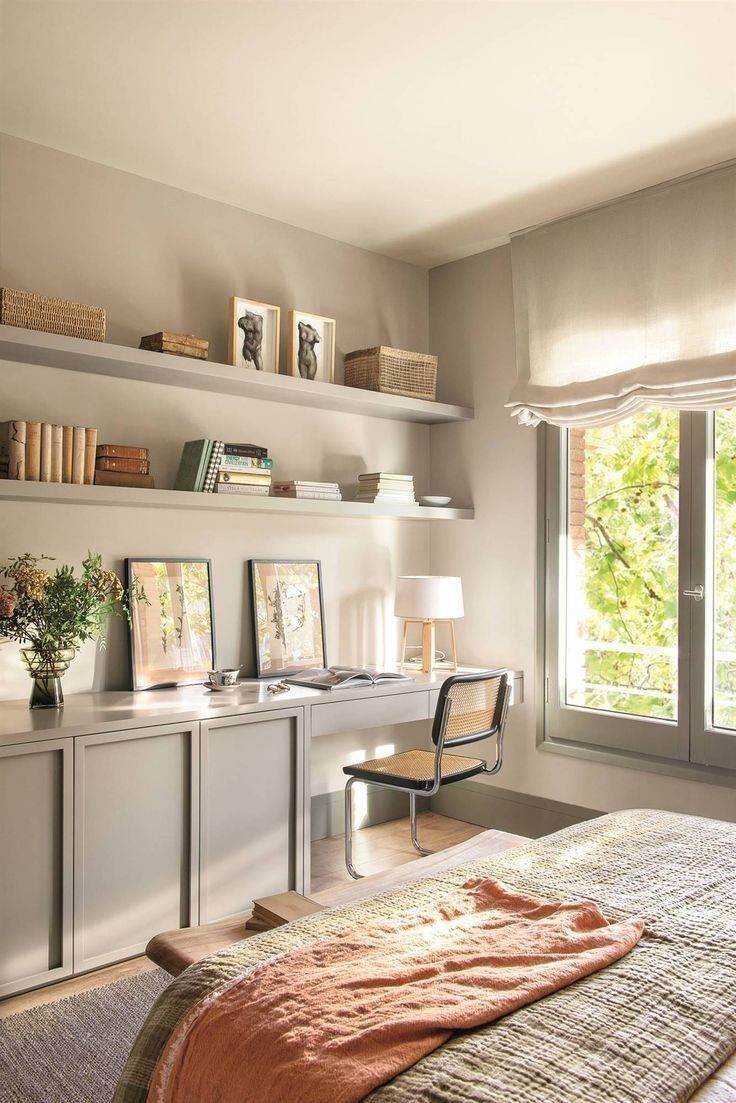
The math of a small bedroom is unforgiving. Closets fill fast. Dressers take up floor space you do not have. Shelves work until they do not, and in a rental, you are usually not putting up more of them. What remains is the zone most people treat as dead space: the several cubic feet of air sitting directly beneath the bed.
It is not glamorous storage. It does not show up in aspirational interior photography. But it is there every night while you sleep, doing nothing, and in an apartment where every square foot is accounted for, that is a kind of waste worth correcting.
What “Under the Bed” Actually Means in Practice
The phrase conjures something chaotic — dust, forgotten luggage, the occasional rogue sock. That reputation is mostly earned by people who shove things under a bed without any container at all. The moment you put a boundary around what lives there, the whole arrangement changes.
The first thing worth knowing is your clearance. Measure from the floor to the bottom of your bed frame before buying anything. Many platform beds and lower-profile frames allow somewhere between seven and twelve inches. That gap determines everything: whether a rigid bin works, whether a soft bag is the smarter call, whether wheels are feasible or just going to scrape along the slats. Measure twice. The return process for a storage bin that does not fit is an annoying errand.
The second thing worth knowing is how often you need to access what you are storing. Seasonal items — heavy blankets in July, lightweight quilts in January — might only come out twice a year. Everyday overflow, the extra sweaters or the gym gear you rotate through weekly, needs to be retrievable without a whole production. These two categories call for different solutions, and mixing them up is how under-bed storage earns its chaotic reputation.
Soft Storage: The Flexible Starting Point
Fabric bags have a few real advantages over rigid bins, and they are not the obvious ones. The main advantage is that they conform. A soft bag will compress slightly to fit through a tighter clearance gap. It will also compress when empty, which means off-season, it lives flat in a closet rather than taking up the under-bed zone when you have freed it up for something else.
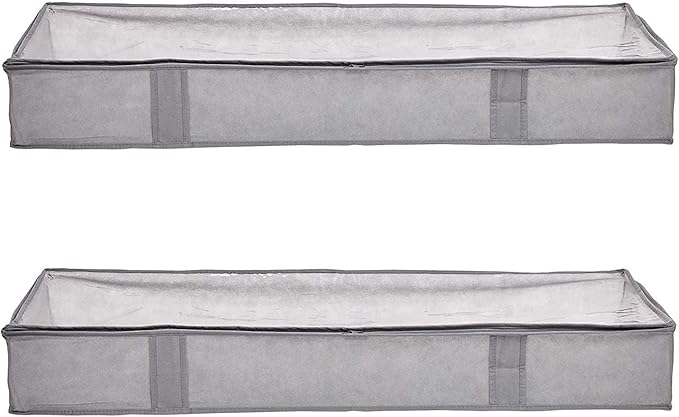
The Amazon Basics Under Bed Storage Bags for Clothes and Blankets are the version of this that makes sense if you are new to the idea and not ready to commit to a larger spend. At $24.93 for two bags, the cost of getting the system wrong is low. Each bag handles bulky items well — comforters, pillows, the kind of chunky knit blankets that take up half a drawer on their own. The two-pack is worth noting specifically: one bag for warm-weather clothes, one for cold-weather, and you have a rotation system that does not require reorganizing every six months.
For anyone who finds one or two bags insufficient, the 5PACK Clear Zippered Storage Bag for Clothes addresses the same problem at a finer grain. Five bags allow you to actually categorize rather than consolidate — dedicated bags for sweaters, for extra linens, for the offseason shoes that do not fit anywhere else. The clear material is a practical feature more than an aesthetic one. When you can see the contents from a standing position before you even crouch down, you stop treating the under-bed zone as a place where things go to disappear.
Soft bags do have a ceiling. If you are storing anything that needs to stay flat, or anything that can be crushed by the weight of whatever is on top of it, fabric is not the answer. And for everyday-access items, the process of unzipping, digging, re-zipping, and sliding back is just enough friction to make you avoid doing it. That is when a rigid option with wheels starts to make the case for itself.
Wheeled Bins: When Access Has to Be Effortless
There is a version of under-bed storage where you never actually use it because getting to it is a minor ordeal. You have to crouch, reach, drag something heavy across the floor, lose your grip, try again. After two or three times, you stop bothering, and the storage becomes ambient clutter you have simply relocated beneath the mattress.
Wheels solve this in a way that sounds minor until you experience it. The EE-RoomWorld Under Bed Storage with Wheels rolls out with one hand using 360-degree rotating casters, which means you can approach it from any angle and it will move cooperatively. It behaves less like a storage container and more like a very low drawer — you pull it out, take what you need, push it back. That behavioral shift matters. Storage you can access without a commitment is storage you will actually use.
The $58.77 price point is a real step up from fabric bags. Whether it is worth it depends on what you are storing and how often you need it. For clothes you rotate through weekly, gym equipment, or anything you would otherwise be opening a dresser drawer for, the friction reduction justifies the cost. For seasonal items you touch twice a year, it probably does not.
Clearance is the constraint here. Wheeled rigid bins need a few more inches of vertical space than soft bags, and they need a smooth floor surface to roll properly. On thick rugs or uneven flooring, even good wheels will fight you. This is worth knowing before purchase.
Building a System That Holds
The mistake most people make with under-bed storage is treating it as a single decision. You buy one thing, put it under the bed, and six months later it contains an inexplicable mix of beach towels, a charging cable, and a book you meant to return to someone. The under-bed zone works best when it is intentional — when whatever lives there has a defined category, a container sized appropriately for that category, and a retrieval process matched to how often you actually need it.
A practical starting point: use the zone closest to the foot of the bed for everyday-access items, where you can reach without kneeling. The deeper zone near the headboard is better suited for seasonal storage, the things you are happy to forget about for months at a time. If your bed sits on a frame with even clearance all around, you have even more flexibility — bags along the sides for seasonal overflow, a wheeled bin at the foot for active rotation.
None of this requires a renovation or a landlord’s permission. It requires measurement, a clear sense of what you are storing, and the willingness to treat the space beneath your bed as part of your apartment rather than underneath it.
In a small home, that distinction is the whole game.
Shop the post
The pieces, sourced
Amazon Basics
Amazon Basics Under Bed Storage Bags for Clothes and Blankets
$24.93 at time of writing
A no-fuss fabric bag that collapses flat when empty and holds a surprising amount when full. The two-pack format is useful for splitting seasonal clothes from spare bedding without buying into a whole system.
Shop the piece →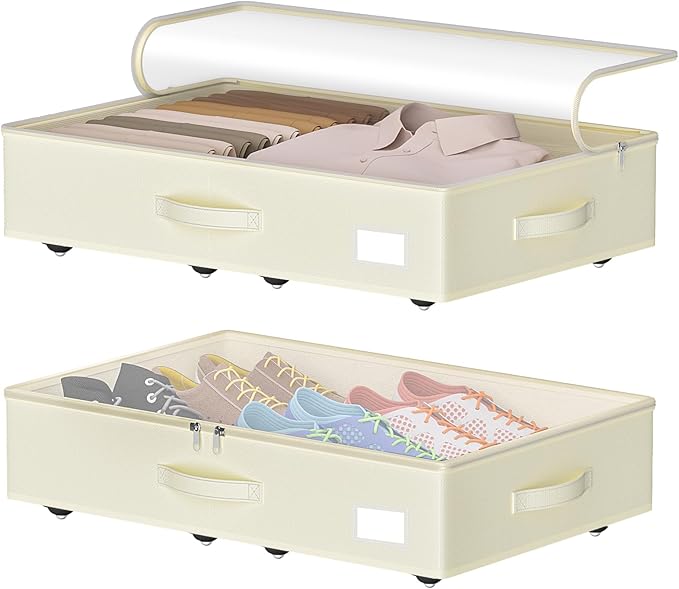
EE-RoomWorld
EE-RoomWorld Under Bed Storage with Wheels
$58.77 at time of writing
A wheeled bin that rolls out like a low drawer, which makes it genuinely usable rather than just theoretically convenient. Eight 360-degree rotating wheels mean you are not dragging anything across hardwood on your knees.
Shop the piece →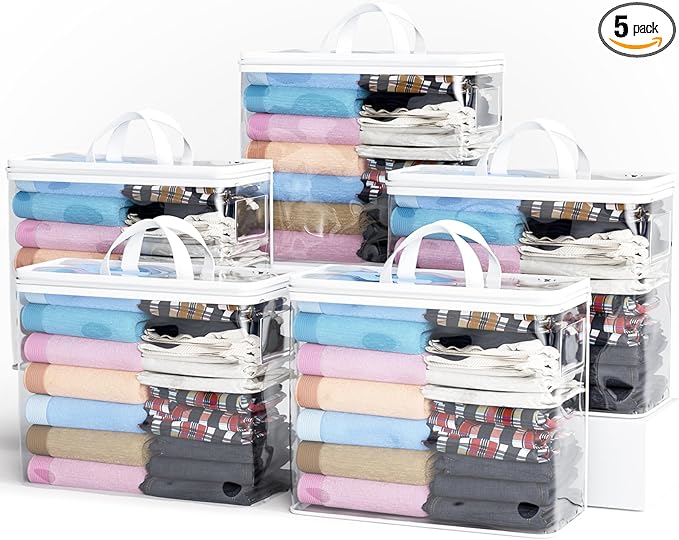
5PACK
5PACK Clear Zippered Storage Bag for Clothes
$25.55 at time of writing
Clear sides remove the guessing game of what ended up where, which matters more than it sounds once something has been under the bed for three months. Five bags give you enough granularity to organize by category rather than just by whatever fit.
Shop the piece →