rental friendly
Entryway Organization for Renters Who Cannot Touch the Walls (Much)
A practical look at how to bring order to a rental entryway without sacrificing your deposit — using freestanding, over-door, and damage-light hardware solutions.
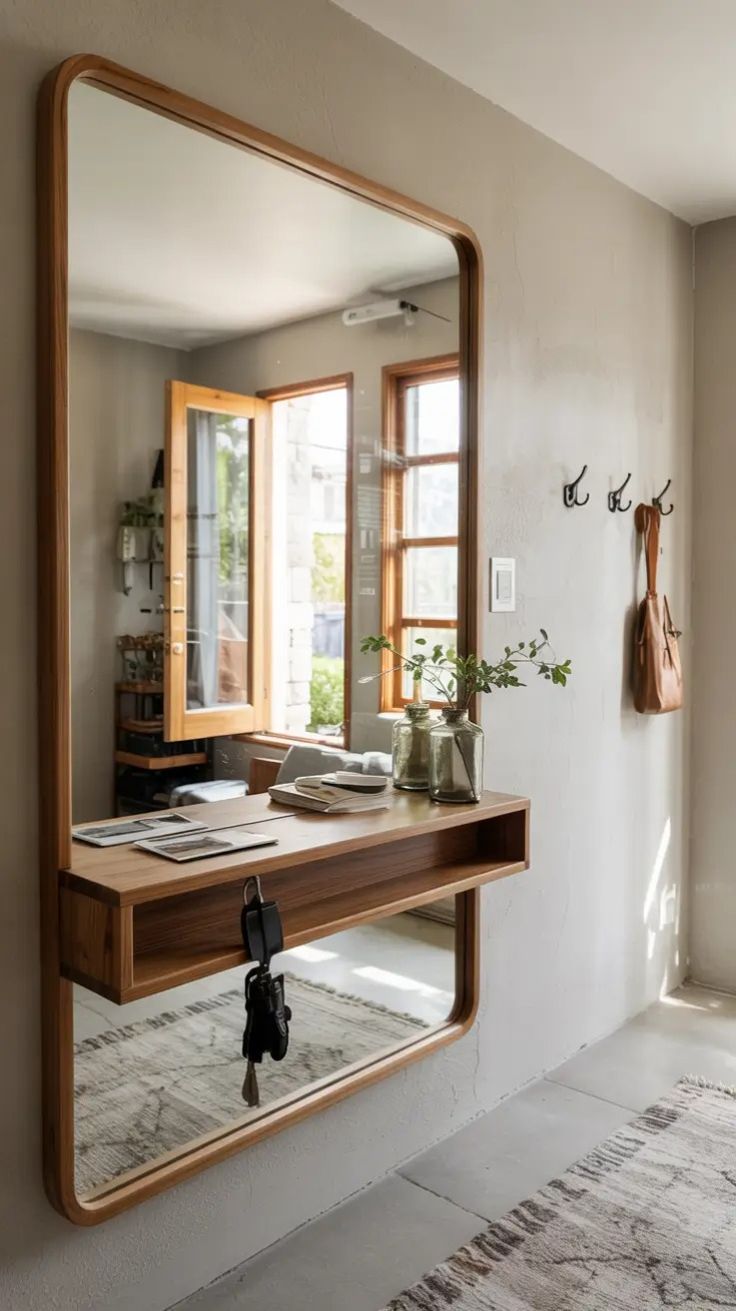
The entryway of a rental apartment is usually a narrow corridor the landlord treated as an afterthought. There is no built-in bench, no coat closet, and the walls are a finish that discourages experimentation. What you are left with is a small patch of floor near the door where bags accumulate, shoes multiply, and mail goes to be forgotten.
The challenge is not purely aesthetic. It is structural. Renters work under a set of quiet constraints — nothing permanent, nothing that will cost you come move-out day, and ideally nothing that looks like a compromise. The best solutions occupy floor space, hang from the top of the door, or use the kind of wall hardware that leaves behind a hole a landlord will consider normal wear and tear rather than damage. Within those limits, the entryway can become one of the most functional rooms in the apartment, even if it is technically a hallway.
What the Space Is Actually Doing
Before adding anything, it helps to think about what the entryway is asked to handle. At minimum: coats, shoes, bags, and keys. In a small apartment, it often absorbs more — umbrellas, dog leashes, reusable bags, the package that arrived yesterday that you have not dealt with yet. The entry is the threshold between the outside world and whatever calm you have managed to build indoors, and when it is cluttered, the disorder follows you in.
The problem is not usually a lack of storage. It is that the storage is not where the habits are. A coat hook placed six inches too far from the door will be ignored. A shoe rack that requires bending down to a precise angle will end up with shoes piled on top of it rather than inside it. Good entryway organization is less about adding more places to put things and more about placing those things directly in the path of the motion you are already making.
That framing — meeting the habit rather than demanding a new one — makes the physical form of each piece worth considering carefully.
Working With the Door Itself
The back of the front door is the most underused surface in most rental apartments. It is large, it requires no wall anchors, and it is right where you need it. An over-door organizer that does not rattle or shift when the door moves is worth finding, because a loose one will eventually annoy you into removing it.
The Consumest Over The Door Hooks Organizer fits over the door frame with two hooked arms and holds two baskets — one open tray at the top and a fine-mesh basket below. The appeal of the mesh is functional: small items do not migrate the way they do in an open wire basket. Keys, a transit card, a lip balm, the things that disappear into bag pockets and surface at inconvenient moments — they stay where you put them. The upper tray handles the larger categories: sunglasses, a phone, whatever comes out of your pockets when you walk in.
At $24.26, it does not ask much. The more meaningful cost is door clearance. Most standard apartment doors close without issue over a hanger this thickness, but if yours has a tight frame or a draft stopper, it is worth checking before ordering. The piece itself is straightforward black powder-coated steel — unobtrusive against a dark door, slightly more visible against white, but not conspicuously utilitarian.
The Floor Plan Problem
Floor space in a small entryway is finite and contested. Whatever occupies it should earn that square footage by doing more than one thing. A shoe rack that only stores shoes is a harder case to make than one that also provides a surface to sit on while putting them on. The sitting part matters more than it initially seems. There is a difference in the quality of the routine — and in the lifespan of the shoes — between sitting to put them on properly versus balancing on one foot near the door.
The Pipishell Bamboo Shoe Rack Bench handles both. The lower two tiers hold shoes on angled bamboo rails; the upper surface is flat and wide enough to actually use as a seat. Bamboo reads warmer than metal shelving and closer to furniture than utility storage, which matters in an entry that guests see immediately upon arriving. It assembles without tools beyond what is included, and it leaves the floor without any anchoring — a requirement for rental use, and for the kind of person who moves apartments more than once a decade.
Sizing is the main variable to consider. The bench is compact but not minimal, and in a hallway narrower than about three feet, it will feel like an obstacle rather than an amenity. In anything wider, it tends to settle into the space and look as though it was always there, which is the quiet goal of most rental-friendly furniture.
Vertical Space and the Case for a Shelf With Hooks
There is usually one wall near the entry — often the one beside the door, sometimes the one opposite it — where a small amount of hardware is worth the two or three screws it requires. A single shelf-and-hook unit in this position can consolidate what would otherwise be spread across several surfaces: the bag that ends up on the floor, the jacket draped over the bench, the keys placed somewhere different every day.
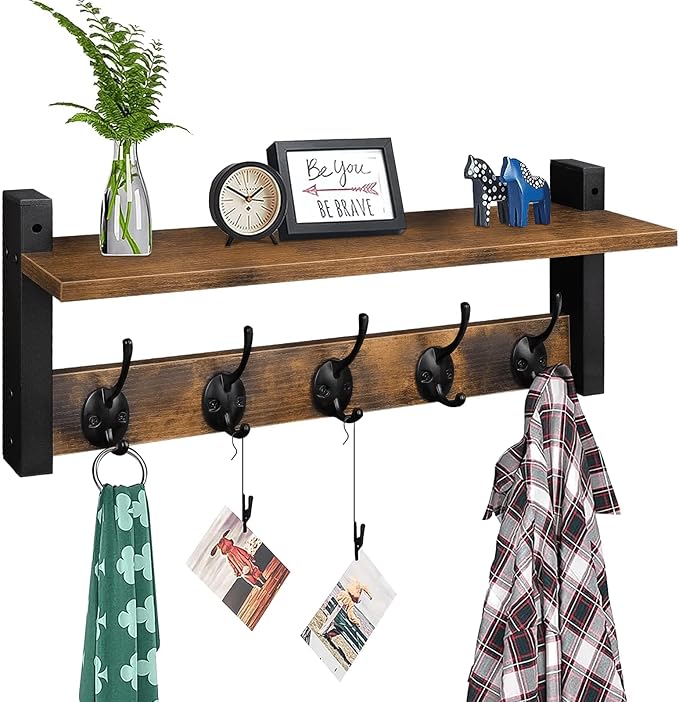
The Homode Wall Hooks with Shelf is a narrow shelf in rustic-finished wood with three iron hooks below it. The combination of materials — warm brown wood grain, matte black iron — has become familiar in the entryway category, but it has become familiar because it works across a range of apartment aesthetics. It does not impose a strong point of view, which is useful in a rental where the surrounding conditions (wall color, floor type, door hardware) are largely fixed.
The shelf surface is shallow — genuinely useful for a small tray, a plant in a compact pot, a stack of cards or letters — rather than deep enough to accumulate clutter. That constraint is actually a feature. A shelf that can only hold a few deliberate things will hold a few deliberate things. The hooks below are fixed in position, which means they are stable under the weight of a coat or a tote bag without flexing. At $26.83 it is inexpensive enough that two of them, mounted in a line, would not be extravagant if the wall allows.
For renters concerned about wall damage, a hook this size requires only two small screws per mount — the kind of repair that touches up cleanly with a bit of spackle. Most leases, read carefully, make this kind of minor penetration permissible, though it is worth confirming before drilling.
Thinking About the Entry as a Whole
These three categories — door-mounted, floor-standing, and wall-hung — are not competing solutions. They work at different heights and serve different habits. The over-door organizer intercepts the smallest, most easily lost objects. The shoe bench anchors the largest and most visually noisy category, footwear, at ground level. The shelf-and-hook unit handles outerwear and daily bags at the height where arms naturally reach.
In a very small entry, two of the three may be sufficient. The door organizer and the bench together address the most common problems without adding anything to the walls. The shelf-and-hook unit becomes most valuable when coats and bags are the primary disorder — when the floor stays clear but every surface the eye lands on holds a jacket or a bag.
What the best rental entryways have in common is not a particular set of products or a visual style. It is that the storage and the behavior are aligned closely enough that maintenance feels automatic rather than effortful. The coat goes on the hook because the hook is there, at the right height, in the right place. The shoes go on the bench because sitting down to remove them is more comfortable than standing. The keys go in the basket because the basket is the first thing visible when the door opens.
That alignment is what makes a small entry feel considered rather than managed. It is a distinction that tends to improve the rest of the apartment by association.
Shop the post
The pieces, sourced
Homode
Homode Wall Hooks with Shelf
$26.83 at time of writing
A strip of matte black iron hooks anchored to a slim rustic shelf. It reads as considered rather than improvised, which is a harder effect to achieve than it sounds at this price.
Shop the piece →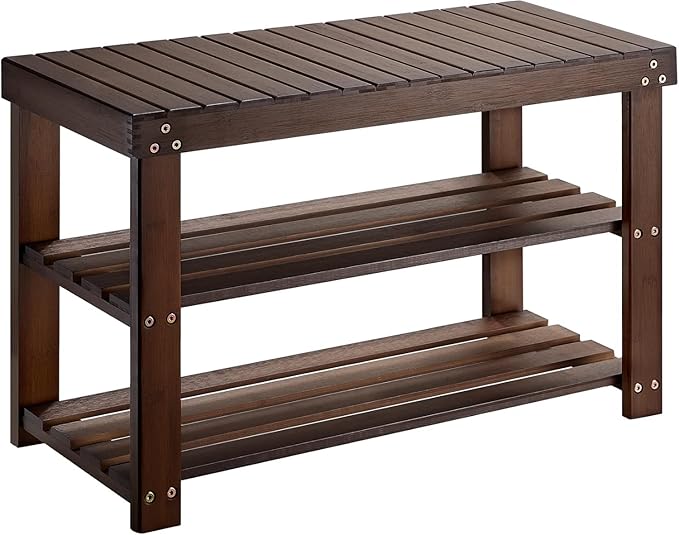
Pipishell
Pipishell Bamboo Shoe Rack Bench
$43.44 at time of writing
Bamboo slats over a two-tier shoe shelf — the upper surface functions as a seat, which earns it the right to occupy floor space in a tight entry. The material sits closer to furniture than to utility shelving.
Shop the piece →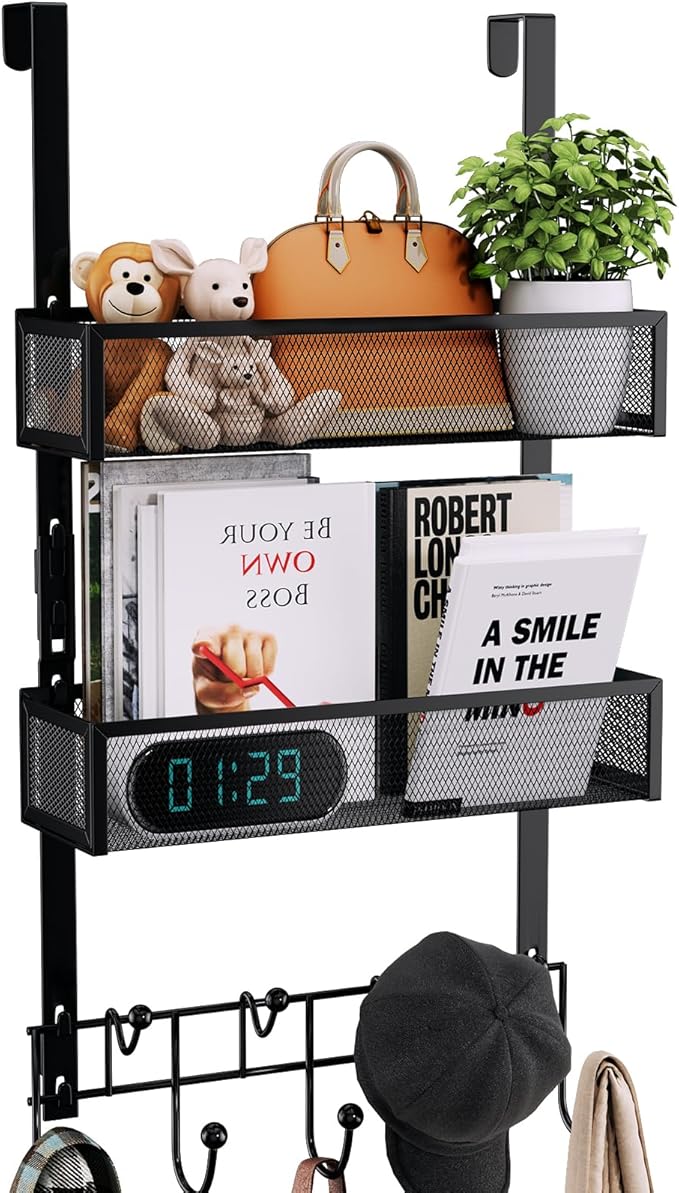
Consumest
Consumest Over The Door Hooks Organizer
$24.26 at time of writing
A double-basket door hanger with a top tray and a fine-mesh lower basket. The mesh keeps smaller items from shifting around, which matters more than it seems when you are reaching for keys in a hurry.
Shop the piece →