office
A Working Home Office in a Small Apartment
How to build a functional, calm workspace when your square footage is limited and your lease forbids drilling.
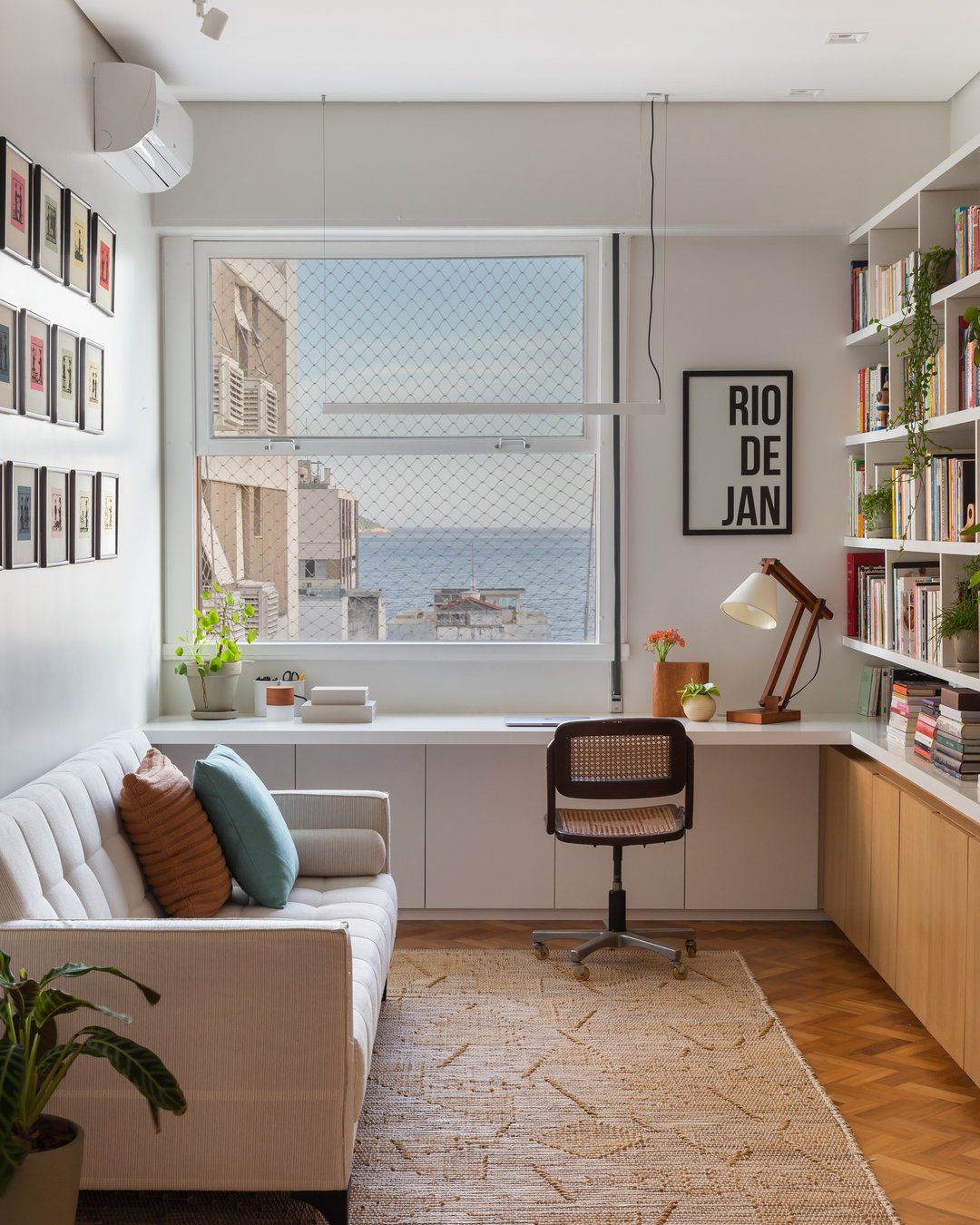
There is a particular kind of problem that reveals itself slowly. You move into a small apartment, arrange the furniture, and feel reasonably settled. Then one morning you open your laptop on the kitchen table, push aside a coffee mug, and realize you have been doing this every day for six months. The kitchen table is your office. The kitchen table is also where you eat, where you sort mail, and where, occasionally, you attempt to fold laundry. It is doing the work of four rooms in one, and it is not doing any of them well.
Building a real home office in a small apartment does not require a spare bedroom. It requires making deliberate decisions about a small number of objects and being honest about which problems actually need solving. The rest — the cable basket from a boutique stationery brand, the matching desk accessories in a single muted tone — is optional. The fundamentals are not.
The Desk Itself, and the Problem of Permanence
The first question is not which desk to buy. It is whether a permanent desk is the right solution at all.
In a studio or a one-bedroom, a desk that lives against the wall full-time is a commitment. It defines the room whether you want it to or not. On a Tuesday at nine in the morning, that definition feels useful. On a Saturday afternoon when you want the space back, it does not.
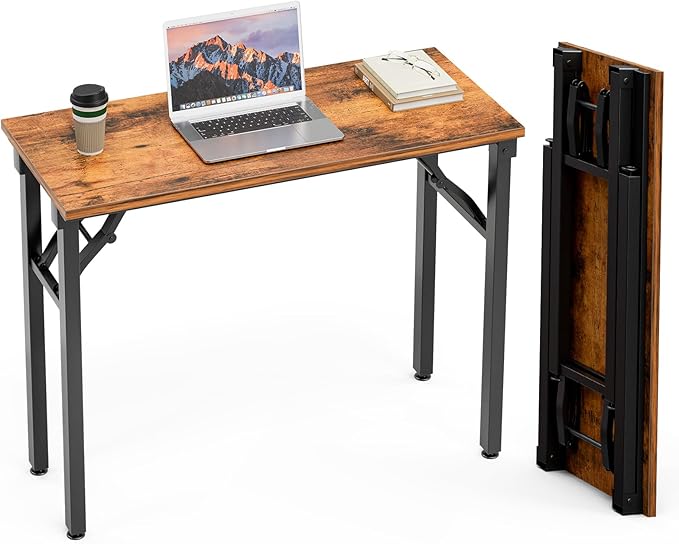
A folding desk reframes the question. The TEMI Small Computer Desk Folding Table is 35.8 inches wide — narrow enough to sit in a hallway alcove or along a bedroom wall without consuming the entire visual field — and it arrives fully assembled, which matters more than it sounds. There is no hardware bag, no instruction sheet, no forty-five minutes on the floor trying to identify which bolt is which. You open the box, unfold the legs, and the desk exists. When work ends, it folds flat and leans against the wall like a large book.
The surface area is enough for a laptop and a secondary monitor, though not both at full spread. That constraint is real. It is also, for most people working from a small apartment, not actually a problem. The act of choosing what has to live on the desk — rather than allowing the desk to accumulate indefinitely — is most of what separates a workspace that functions from one that merely exists.
Vertical Space as Recovered Square Footage
A desk surface is finite. A monitor elevated off that surface is not taking up desk space; it is taking up air, which most apartments have more of than floor. The logic sounds obvious and yet it is consistently underused.
The gianotter Dual Monitor Stand Riser lifts one or two screens to a more ergonomically reasonable height while the area beneath it becomes usable storage. The built-in drawer is the detail that justifies the purchase. It is not large, but it holds the small things that would otherwise migrate across the surface: the USB drive you use once a month, the pen you actually write with, the charging cable for the device that does not have a permanent home. The two magnetic pen holders on either side keep what you reach for most in reach without lying flat.
There is also an ergonomic argument here that is worth making plainly. Working with your neck bent toward a laptop screen for eight hours is a structural problem, not a comfort preference. Elevating the monitor to roughly eye level is not a luxury consideration for a small apartment office. It is the baseline.
Light That Goes Where You Point It
Overhead lighting in apartment rentals is, with very few exceptions, not designed for focused desk work. It is designed to illuminate a room generally, which means it scatters, it casts shadows, and it rarely lands where your hands and keyboard actually are. A desk lamp is not supplementary to overhead light; in most apartment setups, it is the primary light source for the workspace.
The Desk Lamp with USB Charging Port for Home Office is a 24-watt architect-style lamp with two independently adjustable heads. The double-head design allows you to direct light at the desk surface and the keyboard separately, or angle both toward a single task. The result is that the light goes where work is happening rather than spreading indiscriminately toward the ceiling.
The USB port on the base is the kind of small detail that compounds over time. One fewer power brick occupying a wall outlet means slightly less congestion at the power strip, which means the entire cable situation behind the desk starts with a smaller problem to solve.
Architect lamps also have a visual quality that reads as intentional. In a small apartment where the workspace and the living space share the same room, the way things look when work is not happening matters. A lamp that looks like it belongs — rather than like it was chosen for function alone and nothing else — contributes to the sense that the space was considered rather than assembled.
The Cable Problem Is Solvable
Behind every small apartment desk there is a version of the same scene: a power strip lying on the floor, cables fanning out toward the wall and the desk in equal measure, a tangle that defies any single attempt to resolve it neatly. It is not a problem of laziness. It is a problem of geometry. Cables have to go somewhere. Without a plan for where, they go everywhere.
The Cable Management Box takes the power strip and its cables and encloses them inside a single object that can sit on the floor, on a shelf, or on the desk itself. The lid closes. The cords feed in through cutouts on the sides. From any normal viewing angle, the mess becomes invisible — not absent, but contained.
The included cable clips and reusable ties address the cords that travel between the box and the devices: the monitor cable, the lamp cable, the laptop charger. Grouped and clipped to the desk leg or the back edge of the surface, they stop moving and stop accumulating. The wall hook adds an option for mounting the box off the floor entirely, which matters in smaller spaces where every object on the floor reads as clutter.
None of this requires permanent installation. The clips are adhesive and removable. The ties are reusable. The box itself is a box. For renters, that matters.
Setting Up in Practice
The four objects above address four distinct problems: the absence of a dedicated work surface, insufficient desk area for equipment and tools, poor task lighting, and cable disorder. They do not address every possible problem. They do not constitute an aspirational office.
What they constitute is a workspace that is honest about its constraints. The desk acknowledges that space is shared and must sometimes be reclaimed. The monitor riser acknowledges that vertical space is underused. The lamp acknowledges that rental apartment light is inadequate for focused work. The cable box acknowledges that the cords are not going to organize themselves.
The apartment remains the apartment. A folding desk against a bedroom wall, a lamp on one side of it, a monitor at eye level with a drawer beneath it — this is not a transformation. It is a practical arrangement of things that make working from a small space more sustainable over time. That is the actual goal. Not the aesthetic of a workspace, but the function of one.
Shop the post
The pieces, sourced
TEMI
TEMI Small Computer Desk Folding Table - 35.8" Foldable Office
$63.85 at time of writing
A 35.8-inch folding desk that ships pre-assembled and stores flat against a wall when the workday ends. For apartments where a dedicated office room does not exist, the ability to fold a desk away is not a convenience — it is the whole point.
Shop the piece →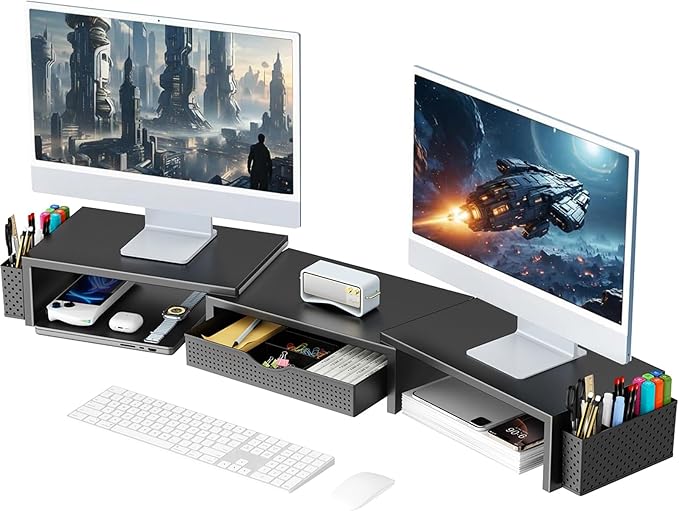
gianotter
gianotter Dual Monitor Stand Riser
$38.33 at time of writing
A monitor riser with a built-in drawer and two magnetic pen holders, which recovers the desk surface that a second screen would otherwise consume entirely. The drawer is shallow but useful — exactly the right depth for a charging cable, a lip balm, and a key you keep forgetting where you put.
Shop the piece →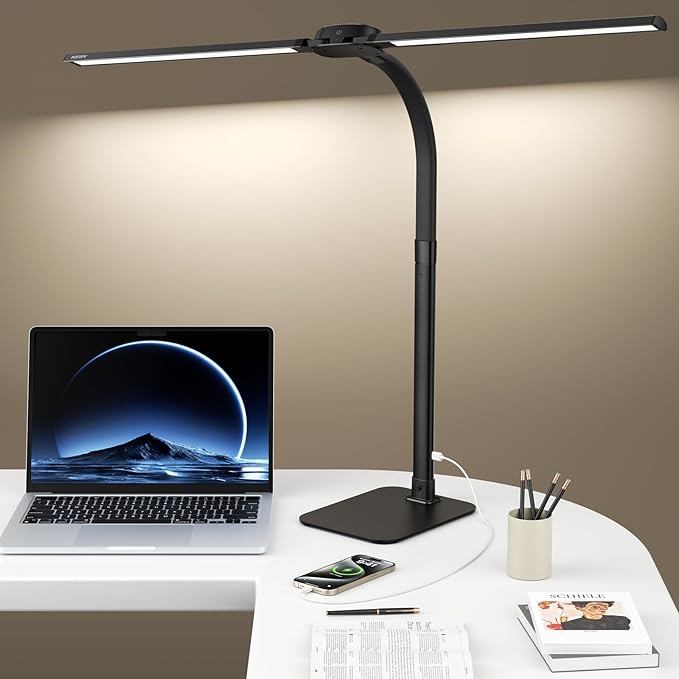
Desk Lamp with USB Charging Port for Home Office 24w Architect
$83.06 at time of writing
A 24-watt architect lamp with a double-head design that rotates freely to direct light at the desk surface rather than into your eyes or onto your screen. The USB charging port on the base means one fewer adapter block occupying a wall outlet.
Shop the piece →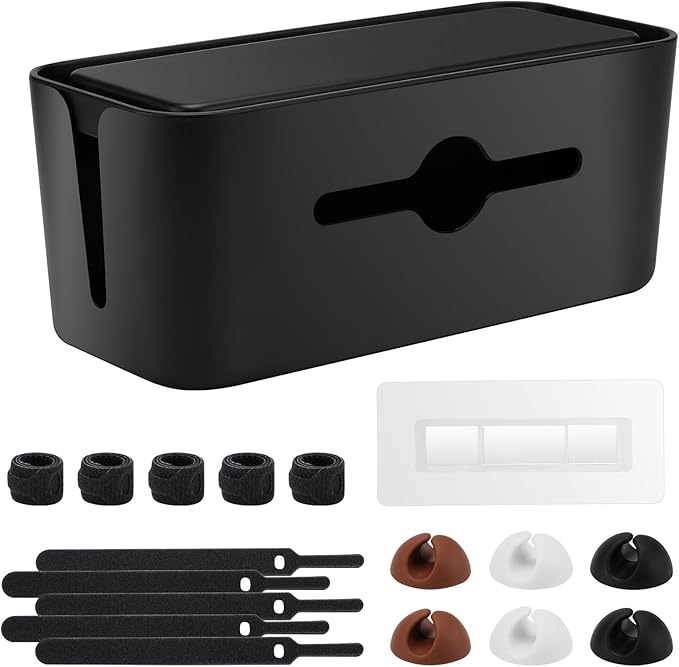
Cable Management Box
$19.16 at time of writing
A cord management box that consolidates a power strip and its tangle of cables into a single contained object. It ships with cable clips, reusable ties, and a wall hook — enough hardware to resolve most of the visible mess without committing a single screw to drywall.
Shop the piece →