storage
Bathroom Storage for Renters Who Cannot Drill a Single Hole
Practical, renter-approved ways to add storage to a small bathroom without touching the walls — no drill, no damage deposit anxiety.
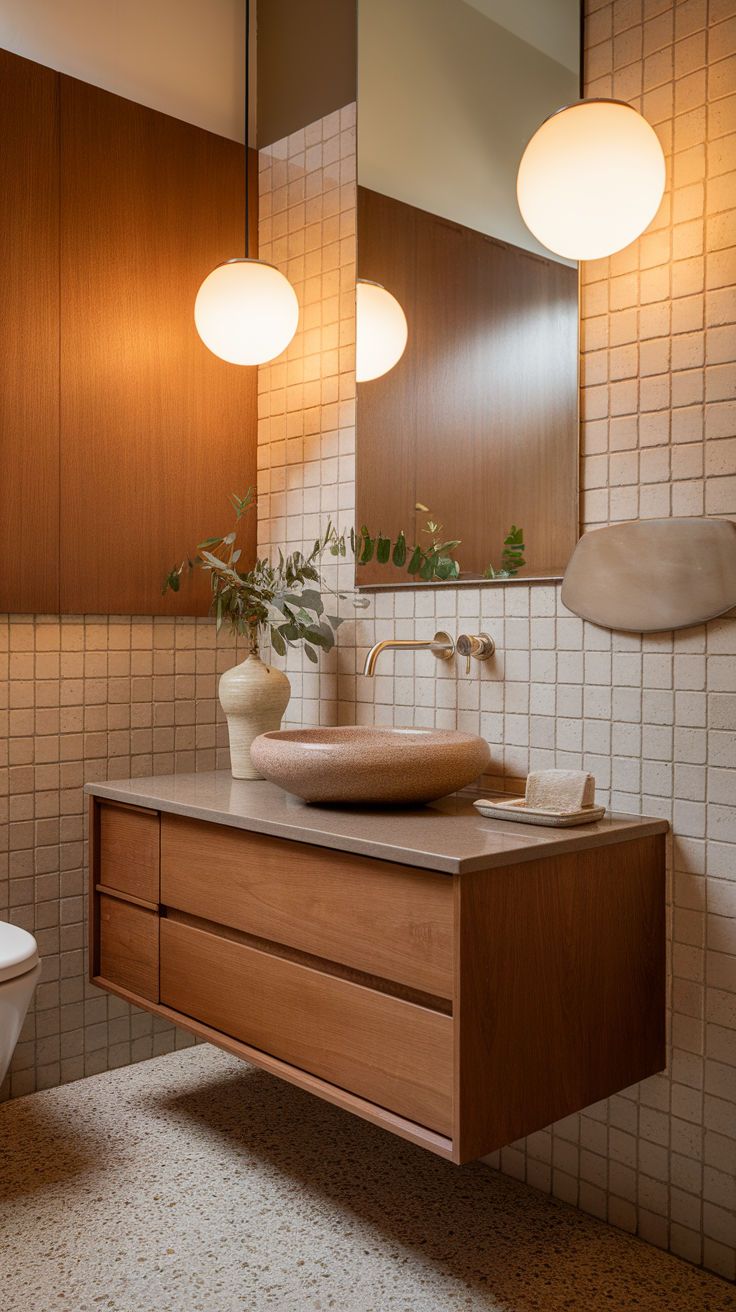
There is a particular kind of stress that arrives when you first unpack your toiletries into a small apartment bathroom. The vanity has one shallow drawer. The medicine cabinet, if there is one, holds perhaps a tube of toothpaste and a bottle of aspirin before it is full. The shower has a single built-in ledge roughly the width of a paperback novel. You stand there holding a basket of shampoo and body wash, doing the math, and the math does not work out.
The instinct is to reach for a drill. The better solution — especially when a security deposit is involved — is to think about the surfaces and structures that already exist in the room: the back of the door, the top of the toilet tank, the tile itself, the shower door frame. Every one of those surfaces is usable without making a single permanent mark. What follows is less a shopping list than a way of rethinking the room you already have.
Above the Toilet: The Most Underused Space in Any Apartment
In a small bathroom, the column of air above the toilet tank is almost always ignored. It is awkward to think about and easy to overlook, which is exactly why it tends to remain empty while towels pile up on the floor and extra rolls of paper get stacked on the back of the tank like a small unsteady cairn.
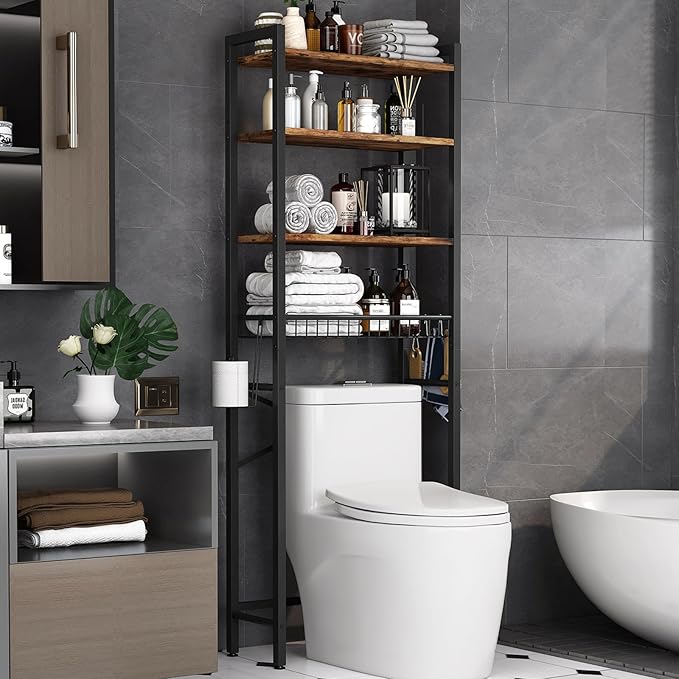
A freestanding over-toilet rack solves this without touching the wall. The Kalrin Over-The-Toilet Storage Rack is one of the more considered options in this category. It straddles the toilet and stands on its own feet, which means installation is really just assembly and placement. Three open shelves handle the things you want visible and accessible — spare soap, a candle, a small plant that tolerates humidity. The enclosed basket on one of the tiers is where the less photogenic items go: the extra toothbrush heads, the backup deodorant, whatever gets restocked in bulk.
The detail that makes this unit more functional than its competitors is the lower compartment. Most over-toilet racks stop at the tank, but this one accounts for the space between the tank and the floor, which can accommodate a slim laundry bin or cleaning supplies that would otherwise take up floor space elsewhere. At 89 dollars it is not the cheapest piece in the room, but it is doing the work of several separate purchases.
The aesthetic question matters here too. Open shelving in a bathroom reads as intentional when what sits on it is edited. Three to five objects, some variation in height, one or two things with visual weight. The temptation to fill every shelf is real, but the restraint is what makes the unit look like a design choice rather than a storage emergency.
The Shower: Two Approaches to the Same Problem
The shower is where renter-friendly storage gets interesting, because there are genuinely two different philosophies at work, and they suit different people and different bathrooms.
The first philosophy is adhesive: bond directly to tile or glass, keep the floor and the door frame clear, achieve a seamless look. The EUDELE Adhesive Shower Caddy operates on this principle. The set includes five pieces — two full caddies, two soap holders, a toothbrush holder — all of which mount via adhesive pads to any non-porous surface. When applied correctly to clean, dry tile and left to cure for 24 hours before loading, adhesive-mount organizers are more reliable than they have a reputation for being. The failure mode is almost always impatience: people load them the same afternoon.
There is something satisfying about an adhesive setup. The pieces sit flush against the wall. They do not swing or rattle. When you leave the apartment, a little heat from a hair dryer releases the adhesive cleanly, and the tile behind it is unmarked. The EUDELE set’s five-piece scope also means you are not immediately running out to find compatible soap dishes to complete the look — it arrives as a system.
The second philosophy is hanging: loop over the shower door or partition rail, use gravity and the door’s edge to hold everything in place, and remain completely commitment-free. The Aitatty Over the Door Hanging Shower Caddy takes this approach. Its two-tier design gives separate real estate to bottles on one level and smaller items — soap, razor, toothbrush — on the other and below. The four removable hooks on the unit mean you can also hang a loofah, a washcloth, or a small mesh bag. Nothing is fixed. The whole thing lifts off in seconds.
Which approach is right depends partly on your shower configuration and partly on your psychology. If the idea of anything permanently adhered to someone else’s tile makes you anxious, the over-door caddy removes that anxiety entirely. If you prefer things to feel built-in rather than improvised, the adhesive route delivers a cleaner result. Both can coexist in the same bathroom — adhesive mounts on the back wall for daily-use bottles, an over-door unit for guest supplies or the overflow that doesn’t fit elsewhere.
Working With What the Room Already Has
Storage solutions work better when they respond to the room’s existing logic rather than imposing a new one. In a narrow bathroom, that means paying attention to the door, the vanity clearance, and the distance between fixtures.
The back of the bathroom door is consistently underused. An over-door rack — not the shower kind but a full-length pocket organizer — can handle the flat items that clutter counters: cotton rounds, travel-size products, small first-aid items, backup toiletries. The door closes the same way it always did. Nothing is different to the landlord.
Under the vanity, if there is one, a small set of stackable bins or a tension-rod shelf kit can double the usable volume without modification. Tension rods — the same spring-loaded type used for curtains — can be positioned horizontally inside a cabinet to create a second tier, or vertically to divide the space into sections. Neither approach leaves a mark.
The counter itself is worth rethinking. Decanting into uniform containers — a pump dispenser for hand soap, a small tray to corral everything near the sink — reduces the visual noise that makes small bathrooms feel chaotic. This is not purely aesthetic. When the counter reads as organized, the limitations of the room register less.
The Cumulative Effect
No single piece solves the small bathroom problem. What does solve it is a series of small decisions that each reclaim a bit of territory — the wall above the toilet, the shower door, the back of the entry door, the unused corners of the cabinet below — until the room works in proportion to how it is actually used.
The constraint of not being able to drill is, genuinely, not much of a constraint. The most effective bathroom storage for renters works with gravity, with tension, with pressure, with adhesion. It is reversible, which means it is also adaptable. A bathroom that was configured for one person’s routine can be reconfigured for another’s in an afternoon.
That kind of flexibility is more useful than any permanent installation, particularly when you do not know yet where you will be living in two years. The deposit stays intact. The storage works. The room feels, against all odds, like it was designed for the way you actually live.
Shop the post
The pieces, sourced
Kalrin
Kalrin Over-The-Toilet Storage Rack
$89.45 at time of writing
A freestanding unit that turns the dead air above the toilet tank into three open shelves and a basket — no wall contact required. The integrated paper holder and removable hooks mean it does several jobs at once.
Shop the piece →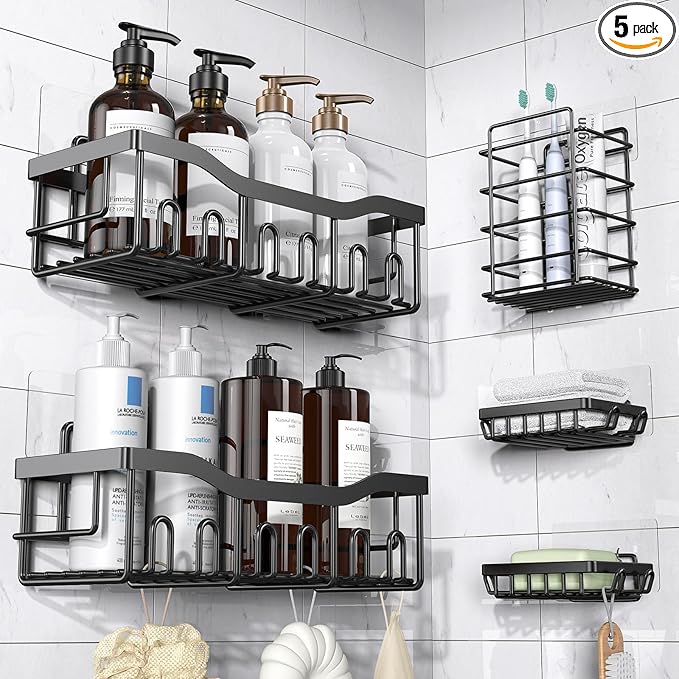
EUDELE
EUDELE Adhesive Shower Caddy
$25.53 at time of writing
Five adhesive-mount pieces — two caddies, two soap dishes, one toothbrush holder — that bond to tile or glass without a fastener in sight. The set is unusually complete for the price.
Shop the piece →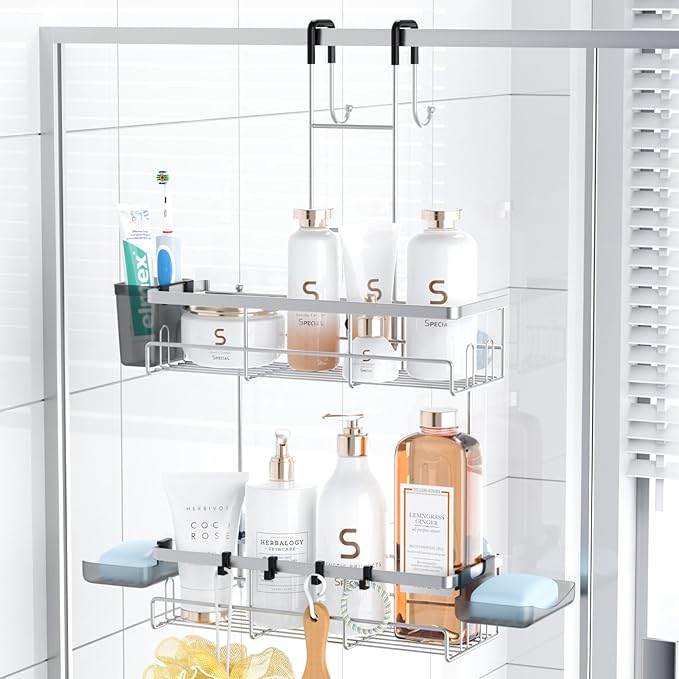
Aitatty
Aitatty Over the Door Hanging Shower Caddy
$27.14 at time of writing
A two-tier caddy that hooks over the shower door or partition and holds bottles, soap, a toothbrush, and four removable hook attachments. Because it hangs rather than adheres, it moves with you when you leave.
Shop the piece →