storage
Doing Laundry Without a Laundry Room
How to manage washing, drying, and storing clothes in a small apartment that offers no dedicated laundry space — without making the whole place feel like a damp basement.
There is a particular domestic frustration that belongs almost exclusively to apartment life: the laundry cycle that has nowhere to land. You wash what you can at a laundromat two blocks away, or you wrestle with a compact portable machine balanced over the bathtub, and then you haul everything back wet and realize the apartment — with its single radiator, low ceilings, and generous collection of furniture — offers nowhere obvious to put it. The clothes sit in the bag a little too long. Things smell faintly of damp. You consider, briefly, whether you should just own fewer clothes.
The problem is not really space. Most small apartments have more usable surface than they appear to at first glance. The problem is infrastructure — the absence of a dedicated zone for the in-between state of laundry, that liminal period when clothes are neither clean and put away nor visibly dirty. Managing that gap well is mostly a matter of having the right portable equipment and a consistent routine for deploying and stowing it.
Why Air Drying Makes More Sense Than You Think
Laundromats charge for dryers by the cycle, and those cycles are rarely gentle. Knitwear, linen, anything with elastic — all of it ages faster in a commercial tumble drum. Air drying preserves fabric in a way that is not a lifestyle affectation but simple physics: lower heat, no mechanical agitation, and the ability to dry flat or hang as the garment requires.
In a small apartment, this becomes an asset rather than a concession. A single drying rack, positioned near a window or in any room with reasonable airflow, handles a standard load in twelve to twenty-four hours depending on the season and how heavily you loaded it. In summer, near a cracked window, it goes faster. In winter, near a radiator, it goes faster still — and the evaporating moisture adds some humidity back to air that central heating has made painfully dry.
The key variable is not the rack itself but where you put it and for how long. A rack set up in the bathroom or a hallway becomes invisible within a day or two of laundry day. A rack left out all week becomes furniture.
Choosing a Rack for Rental Conditions
The constraint that defines most rental apartments is the floor plan you cannot change. You cannot install a wall-mounted retractable line — or if you can, you will be patching the wall when you move out. You are working with freestanding equipment that needs to earn its square footage every time it is used, and justify its storage footprint on every day it is not.
That is a demanding brief. It rules out large wooden frames with decorative dowels. It rules out anything that requires two people and ten minutes to assemble. What it leaves is a category of metal folding racks that expand for use and collapse flat for storage, and within that category there is more variation in quality than the price range suggests.
The ZOES HOMEWARE 2026 Enhanced Clothes Drying Rack | Foldable sits at the practical end of that range. The 2026 version updated the frame materials to increase load capacity — useful if you are drying heavier fabrics like towels and denim rather than separating them into multiple small loads. It folds down to a profile that slides behind a door or along the side of a wardrobe without demanding much negotiation with the rest of the room.
For those who prefer a more minimal object, the Amazon Basics Foldable Portable Metal Clothes Drying Rack does exactly what its name describes, with no surplus features. It is the kind of product that does not ask you to think about it, which has its own value. Metal construction, standard folding mechanism, indoor use. When you do not need it, it leans against a wall and reads as a rack rather than clutter.
Making the Most of Vertical Space
One of the persistent myths about small apartments is that the solution to limited floor space is always to go vertical — floating shelves, wall hooks, tall bookcases. This is partly true, but it understates how often the floor is actually available and underused. A dining table gets cleared after meals. A bedroom floor is mostly open when the bed is made. The constraint is usually temporal, not spatial: you just need the floor for a few hours in the morning, then you want it back.
A collapsible rack that genuinely collapses — rather than one that reduces from large to merely medium — respects this. The Honey-Can-Do Collapsible Laundry Drying Rack is designed around this premise. Its collapsed form is legitimately narrow, which means it stores in places that other racks do not: inside a closet, between the refrigerator and a wall, behind a sofa that is not flush against the baseboard. The footprint it occupies when in use is modest enough to work in a living room without dominating it.
This matters because in a studio or a one-bedroom, the living room is often the best drying location. It tends to be the largest room, the one nearest windows, and the one where air circulates most freely. Accepting this and planning around it — rather than trying to hide laundry in a hallway where there is no airflow — produces better results and less resentment about the arrangement.
Telescoping and Adjustable Designs
Standard folding racks have a fixed footprint when open. For most loads that is fine. But there are situations — a large wash before a trip, a week of rainy weather that has backed things up — where you want more drying surface than a single standard rack provides without bringing out a second rack and turning the apartment into something that resembles a ship’s rigging.
An adjustable design addresses this. The Drying Rack Clothing uses a telescoping mechanism that lets you extend or contract the rack to match the load. This is more useful than it sounds. A half-load of delicates does not need the same footprint as a full wash of gym clothes, and being able to right-size the rack to the task means a smaller object in the room for smaller jobs. When it is done, the same telescoping action compresses it for storage.
The value of this adjustability is mostly ergonomic — it reduces the sense that the rack is taking over — but it also means the rack can fit into spaces that a fixed-width design could not. A narrow bathroom, a galley kitchen with a window at the end, a bedroom alcove that is almost but not quite wide enough for a standard frame.
Living With the System
No piece of equipment solves the laundry problem in a small apartment entirely. What these racks do is make the in-between state manageable rather than intrusive. The discipline that actually makes the difference is simple and unglamorous: take the clothes off the rack the same day they are dry, fold or hang them immediately, and put the rack away before you go to sleep. Done consistently, this keeps the apartment from acquiring the air of a permanent drying station.
The other adjustment is spatial honesty. Trying to hide the drying rack in a corner where there is no airflow, because it feels less obtrusive there, extends drying time and makes mildew more likely. A rack positioned in good light near a source of moving air — even a gentle ceiling fan — does its job faster, which means it is folded and gone sooner. The less you try to make laundry invisible while it is happening, the more invisible it becomes overall.
Small apartments require this kind of trade, consistently. You accept the object in the room in exchange for having the room back in a day. The rack is not a permanent feature. It is a tool with a schedule.
Shop the post
The pieces, sourced
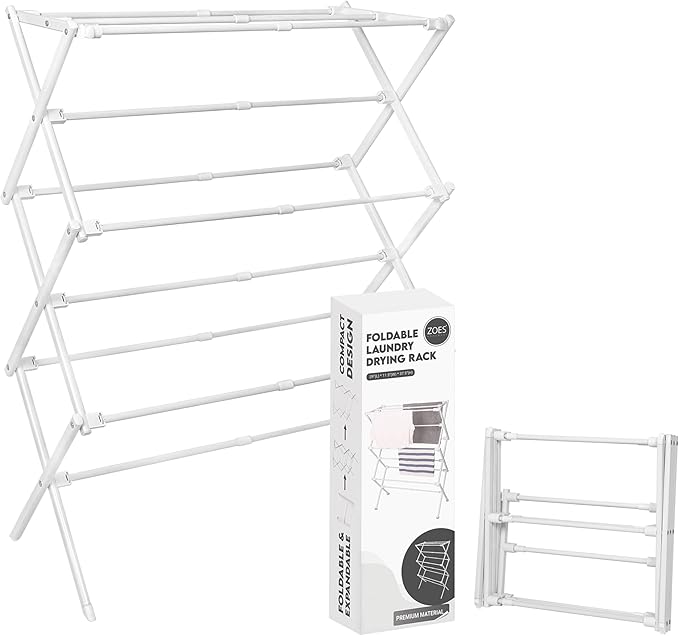
ZOES HOMEWARE
ZOES HOMEWARE 2026 Enhanced Clothes Drying Rack | Foldable
$33.30 at time of writing
A reinforced rack that folds flat when you need the floor back. The revised assembly makes setup feel less like a puzzle and more like unfolding a chair.
Shop the piece →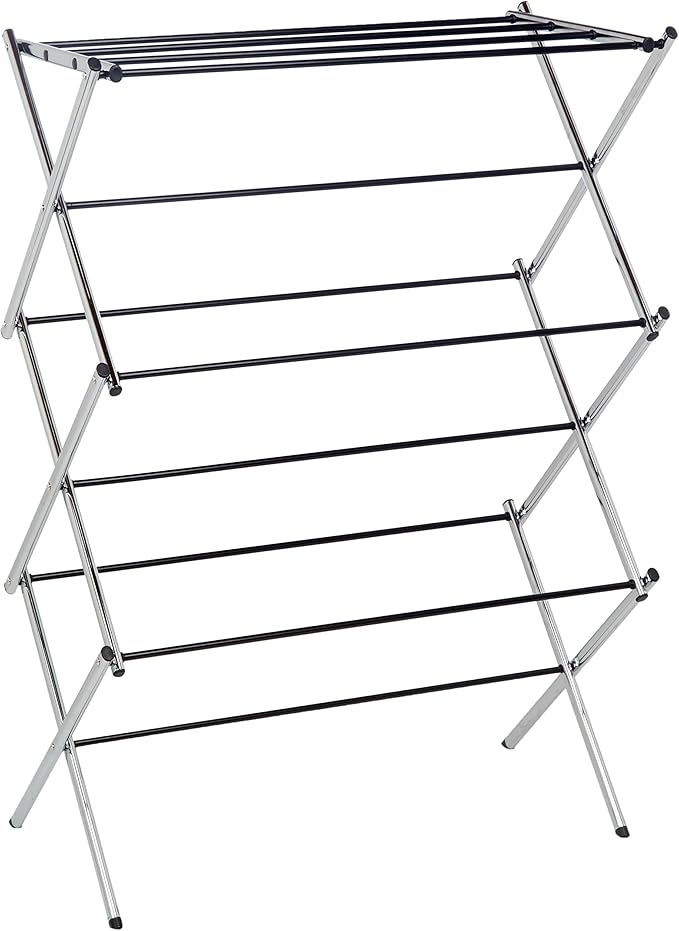
Amazon Basics
Amazon Basics Foldable Portable Metal Clothes Drying Rack
$42.70 at time of writing
A straightforward metal rack built for indoor air drying. Nothing decorative about it, which is exactly the point — it works, folds, and gets out of the way.
Shop the piece →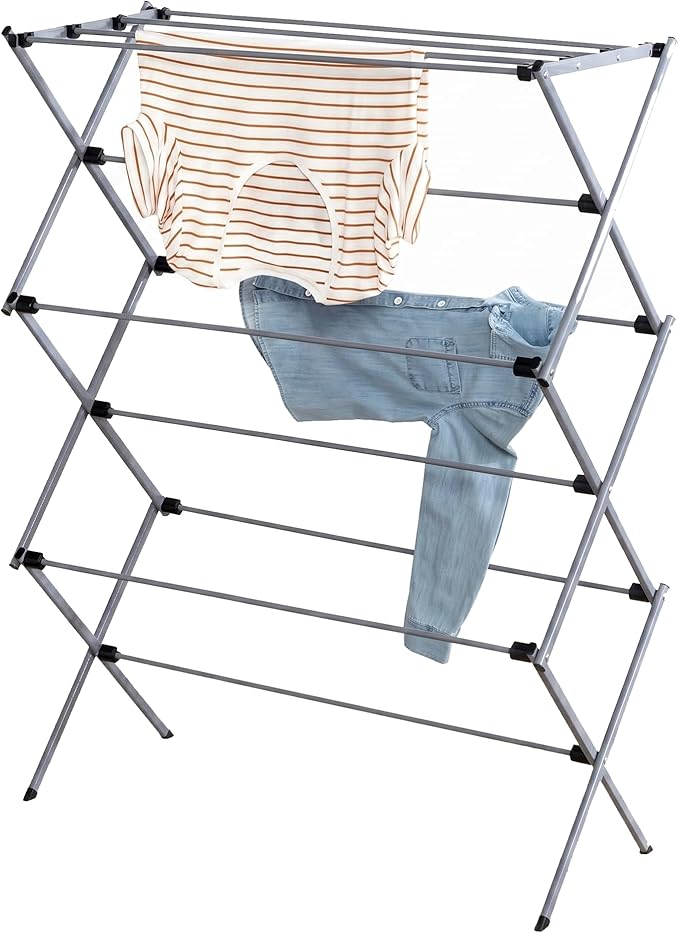
Honey-Can-Do
Honey-Can-Do Collapsible Laundry Drying Rack
$42.70 at time of writing
Designed to collapse into a genuinely slim profile, this rack earns its keep in apartments where the closet is already doing too much work.
Shop the piece →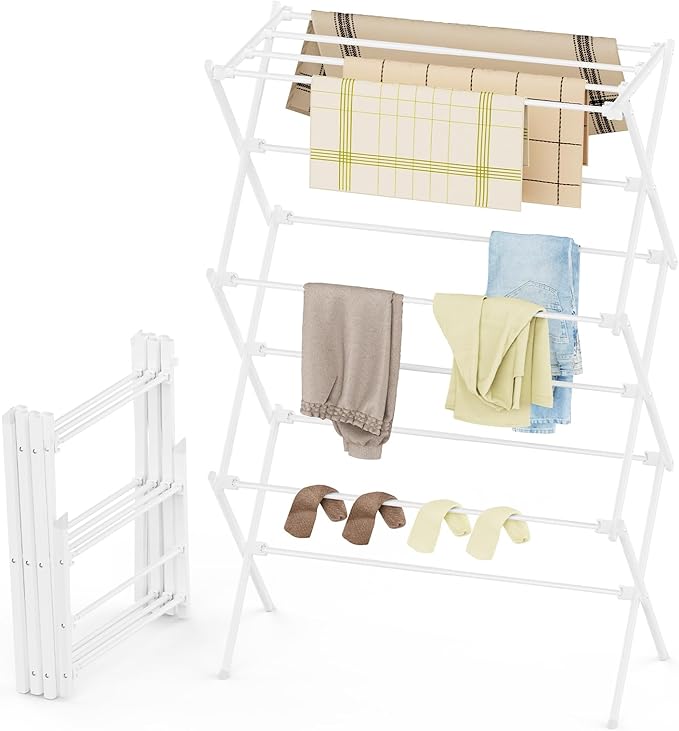
Drying Rack Clothing
$32.02 at time of writing
A telescoping, foldable design that adjusts to fit the load and then disappears into a gap between the washer and wall — or wherever you can negotiate a few inches.
Shop the piece →